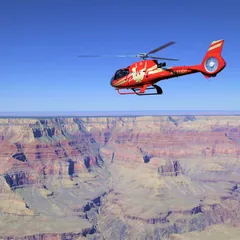
Grand Canyon National Park: South Rim Scenic Helicopter Tour
★ 4.9 · 1,935 reviews
- Grand Canyon National Park: South Rim Sc
- Grand Canyon National Park
- Bestseller
- Free cancellation
Weather
Two things stop flights over this canyon, and neither is the one people expect. It is almost never rain. It is wind over the rim, which builds through any warm afternoon, and the North American monsoon, which from early July puts thunderstorms over the plateau on most days. Both are morning-friendly, which is why every experienced answer here ends the same way.

Quick answer
Flights are postponed rather than cancelled, and the decision is usually made on the morning itself. Most listings here carry free cancellation up to 24 hours before, and if the operator grounds the flight you are rebooked or refunded. What makes the difference is having another day in your trip — which is why we keep saying to book a Grand Canyon helicopter tour for the first days rather than the last.
What actually stops a flight
Wind first, the monsoon second, winter fronts third, smoke occasionally. Rain is almost never the reason.
1. Wind over the rim. The plateau heats hard and the canyon edge generates turbulence as the day goes on. It is rarely dangerous and it is frequently uncomfortable, and operators would rather move a Grand Canyon helicopter tour than fly a marginal one. This is the most common reason by a distance.
2. The monsoon. From early July to early September, moist air pushes north and builds cumulus over the plateau through the morning and thunderstorms by mid-afternoon. It is remarkably predictable, which is why summer mornings fly and summer afternoons often do not.
3. Low cloud and snow in winter. A front over the rim at 2,100 metres can close a morning. It usually clears by the afternoon, which is the one season where the afternoon slot is the safer bet.
4. Visibility. Rare, but wildfire smoke in late summer can close the long views while leaving the air perfectly flyable. Operators will tell you honestly if the corridor is hazy.
What happens to your money
Six situations and what each one means in practice.
Free on most listings here. Cancel and rebook for another day in the same trip.
Depends on the listing, and several West Rim flights close bookings ten hours out. Talk to the operator rather than clicking cancel.
The most common outcome. They offer another slot, usually later the same day or the next morning. Nothing is charged twice.
You are rebooked or refunded. The operator handles it and the booking platform backs it.
Treated as a no-show. Check in forty-five minutes ahead; Tusayan is small but the road from the village can be slow in season.
Occasionally an operator will fly a reduced route rather than cancel. You should be offered the choice, not told after landing.
The practical version of this entire page: book a morning slot in the first half of your trip. Wind, monsoon and winter fronts are all survivable if there is another morning to move to.
When to fly→Book direct
Four listings with the flexibility that makes a weather postponement painless.
★ 4.9 · 1,935 reviews
★ 4.7 · 3,052 reviews
★ 4.8 · 1,608 reviews
★ 4.6 · 385 reviews
The monsoon, specifically
Cumulus by late morning, thunderstorms by mid-afternoon, most days from July to early September.
It is the one seasonal pattern worth understanding, because it is predictable enough to plan around.
What happens. From early July, moist air pushes north over Arizona. It heats against the plateau through the morning, builds cumulus by late morning, and turns into thunderstorms by mid-afternoon. Most days. It typically eases in early September.
What it means for booking. A Grand Canyon helicopter tour at 08:00 in July is usually a beautiful flight in clean, cool air. The same flight at 15:00 is the most likely thing on this page to be moved.
The upside nobody mentions. Monsoon mornings are often the clearest of the summer, because the previous afternoon’s storms wash the haze out. And the storm cells themselves, seen from the rim in the evening, are spectacular.
What to do. Book the first slot, book it for the first half of your trip, and keep the afternoon free rather than stacked.
Reading the forecast yourself
You will not be making the call, but knowing what it rests on makes the message make sense.
The most common reason a Grand Canyon helicopter tour is moved, and it builds through any warm afternoon.
From July, the probability of thunderstorms over the plateau by mid-afternoon.
A low base over a rim at 2,100 metres closes the corridor even when the valley is clear.
Late-summer wildfire smoke can close the long views without touching the flyability.
Thin, hot air reduces performance. On the hottest afternoons load limits tighten.
Almost never the deciding factor by itself.
Common questions
The operator normally postpones and offers another slot, often later the same day. If they ground it outright you are rebooked or refunded.
Light rain is rarely the problem — wind and visibility are. A wet morning with still air often flies; a dry, gusty afternoon often does not.
Summer afternoons, from early July to early September, when the monsoon builds thunderstorms over the plateau.
Yes, free on most listings up to 24 hours before. Inside that window, talk to the operator — they are watching the same forecast and would rather move you.
Occasionally a winter morning, rarely a whole day. The rim is at 2,100 metres and gets real snow; the canyon floor almost never does.
No. It is the one mistake that turns a postponement into a lost flight.
Go deeper
From $174 to $999, and what a minute in the air is worth.
The verdictOne recommendation for each kind of traveller, and why.
South RimThe national park itself — and why nothing lands there.
West RimHualapai land, the Skywalk, and the only legal landings.
LandingsFour thousand feet below the rim, and where it is allowed.
The rideCheck-in, the weigh-in, the doors, and the first drop.